What causes tendinitis?
Tendinitis suggests inflammation, and in the first days that is often true. Past a few weeks the picture changes: the tendon has not stayed inflamed, it has remodeled badly. The fibers disorganize, the tissue loses its ability to store and return energy, and the tendon simply cannot carry what it used to. That is tendinopathy, and it is the version most people arrive with. It matters because inflammation calls for calming things down, while a degenerated tendon calls for load. Give it the wrong one and the pain keeps coming back.
Tendons adapt slowly, more slowly than muscle. When the volume, the intensity or the surface changes faster than the tendon can keep up, capacity falls behind demand and the tissue starts to break down. A new running program, a job that suddenly involves a ladder, a return to the gym after a layoff. The load itself is not the enemy. The rate of change is.
This is the trap. Rest quiets an angry tendon, so it feels like the right answer. But an unloaded tendon keeps losing tolerance while it is resting, so the moment you go back to the activity, the same load meets a weaker tendon and the pain returns worse. Tendons need work to reorganize. The skill is finding the dose that stimulates them without flaring them, and then raising it.
Some tendons get pinched against bone at the end of a range: the Achilles at its insertion on the heel, the gluteal tendons on the outside of the hip, the hamstring at the sit bone. Deep stretching and crossing your legs make these worse, not better, even though stretching feels productive. Positioning matters as much as strengthening here, and the fix often starts with what to stop doing.
A tendon usually fails because something near it stopped doing its share. A stiff ankle sends load into the Achilles. Weak hips send it into the patellar tendon. A shoulder blade that will not rotate upward sends it into the rotator cuff. Treating only the sore tendon leaves the reason intact, which is why the flare returns as soon as you resume the activity that caused it.
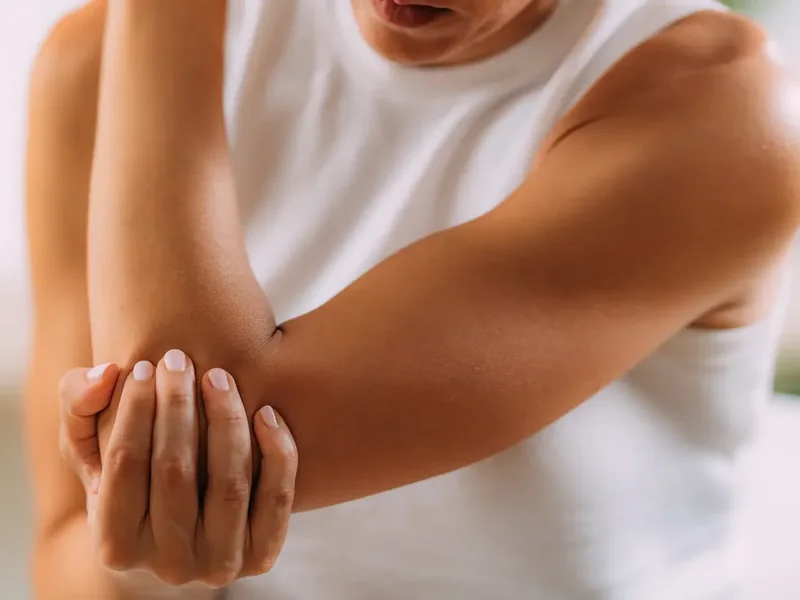
Tennis elbow and golfer's elbow are rarely caused by tennis or golf. They come from gripping and gripping: tools, a mouse, a steering wheel, a racquet handle, a bar. The forearm tendons never get a quiet day. Changing the grip, the tool and the height of the work, and then building the tendons a wider margin, is what stops it recurring after you go back to the same job.
An anti-inflammatory helps a tendon that is genuinely inflamed. It does very little for one that has degenerated, and repeated cortisone into a load-bearing tendon can leave the tissue worse off in the long run. That is a conversation for you and your physician. What we can tell you is that nothing on that list builds tendon capacity, and capacity is the thing that failed.