Fittees Physical Therapy and Wellness

Hip & Knee Pain Treatment in Sachse

The first few minutes are fine, then it builds, and now you pick your activities around a knee that used to be a non issue.

01What Causes It

What causes hip and knee pain?

The knee is an honest joint. It reports problems, but it rarely causes them. It sits between a hip that steers the leg and a foot that meets the ground, and when either of those does its job badly, the knee absorbs the difference. The hip is subtler about it: it hides its own restrictions until the back or the groin starts complaining. So the question is never only where it hurts. It is which link stopped contributing, and what has been quietly compensating ever since.
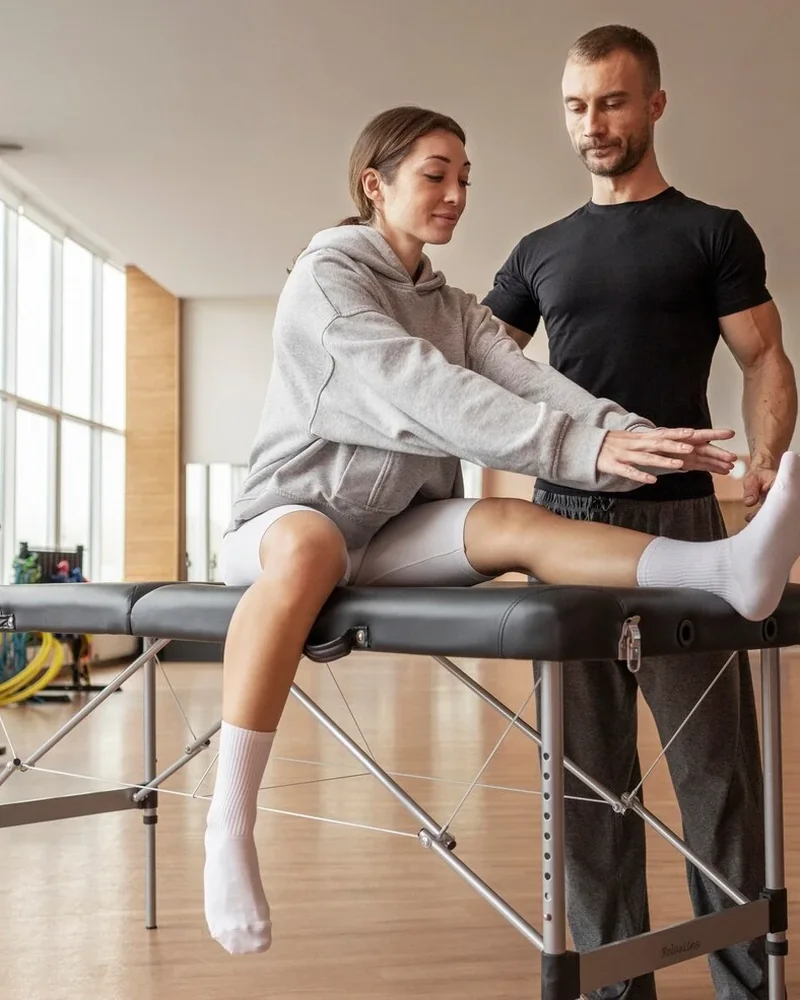
Doctor of Physical Therapy assessing hip and knee strength during a lower limb evaluation in Sachse

Pain around or under the kneecap that worsens on stairs, on hills and after long sitting is the most common knee complaint we see. The kneecap has to track through a groove, and the muscles controlling the thigh bone underneath it decide how well that goes. Weak or slow gluteal muscles let the thigh rotate inward and the kneecap runs off line. Strengthening the hip usually does more than anything aimed at the kneecap.

Pain on the outside of the hip, worse lying on that side at night and worse again after sitting cross legged, is usually the gluteal tendons rather than a bursa. Compression is the aggravator: positions that press the tendon against the bone keep it irritated day after day. The treatment is unloading those positions first, then progressive strengthening. Stretching it aggressively, which is most people's instinct, tends to make it angrier.

Joint changes on imaging are common and are a poor predictor of pain. Plenty of people have them and no symptoms at all. What determines how an arthritic joint feels is the strength around it, the range it has kept, and how much load it is asked to take at once. Strengthening reduces pain and improves function in arthritic hips and knees, and it keeps working as long as you keep doing it.

The meniscus spreads load across the knee. It can tear traumatically in a twist, or it can fray gradually with age, and the second kind often hurts without ever needing surgery. Locking, genuine giving way and a knee that will not straighten need imaging. A knee that aches under load and settles with rest usually responds to graded strengthening and a change in how the joint is being loaded.

When the hip loses rotation or extension, that movement has to come from somewhere, and the knee and the lower back are the nearest donors. You feel it as knee pain while the hip is the restricted joint, or as back stiffness after a long walk. Testing hip range on both sides and comparing them is often what finally explains a knee problem that has never made sense.

Tissue adapts to what you ask of it, provided the ask increases gradually. A new training block, a return to sport after a break, a house move or a job change that puts you on your feet all raise demand faster than tendon and cartilage can build tolerance. Nothing is damaged. Demand simply overtook supply. Fixing it means honest load management alongside the strengthening, not stopping altogether.

Patient performing a loaded step up exercise during a one on one hip and knee session
02How PT Helps

How physical therapy in Sachse helps.

We test the whole chain, because treating only the painful joint is why so many knees come back. Dr. Egbuzie measures hip and knee strength side to side, checks hip and ankle range, and watches you perform the movement that actually hurts: the stair, the squat, the stride. Then the plan targets the link that failed. Manual therapy and dry needling bring pain down and give back the range you are missing, which makes real strengthening possible sooner. From there it is deliberate loading, progressed week over week, until the joint can handle the demand you genuinely place on it. Sessions run 45 to 60 minutes with your Doctor of Physical Therapy, one on one, and you do not need a physician's referral to begin because Texas is a direct access state. Most patients feel a meaningful change inside the first two or three visits.

03What To Expect

What to expect from your recovery.

01

The evaluation

Strength tested and compared side to side, hip and ankle range measured, and the painful task performed while we watch it happen. You leave knowing which link is weak, what the plan is and what it costs. Fittees is in-network with Blue Cross Blue Shield, UnitedHealthcare, Cigna and Medicare, and for other plans we provide a detailed superbill so you can file for reimbursement, with no surprise bill later.

02

Settling the joint, restoring range

Pain limits how hard you can train, so it comes down first. Hands-on work and dry needling reduce the irritation and give back the hip or ankle motion your knee has been borrowing. We adjust your current load so the joint stops getting provoked daily, without asking you to stop moving altogether.

03

Loading it back to your real demand

Strength work progresses toward the thing you want back: the stairs, the hills, the run, the shift on your feet. We rebuild the hip, the quadriceps and the calf under real load, then test them again against your baseline. A typical plan runs two to three visits a week for four to six weeks, and you leave with the program that maintains it.

In Their Words
The knee is usually the place it hurts, not the place it went wrong. Treat the link that failed and the pain stops needing to be managed.
Fittees Physical Therapy and Wellness
Related Conditions

Pain rarely travels alone.

Request an Appointment

Ready when you are.

HoursMonday - Saturday
Walk-insCall ahead
Book your evaluation. Same-week appointments available.
Step 1 of 5
First things first. What's your name?
We'll need a name to book you in.
Best number to reach you?
A phone number lets us confirm same-day.
And your email?
We'll send your confirmation here.
What questions do you have about your hip or knee?
A few words is all we need.
Look right? Send it.
✓
Request received.

We'll call within business hours to lock in your time.

Schedule Appointment