Fittees Physical Therapy and Wellness

Spinal Manipulation in Sachse

Your neck has been locked since you woke up, and checking your blind spot means turning your whole body.

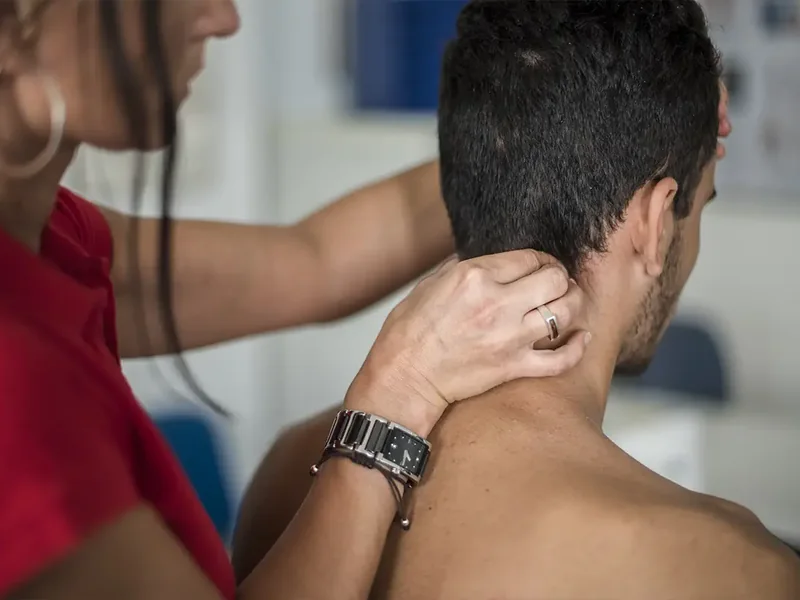
Doctor of Physical Therapy assessing a patient's spine before manual treatment
01What It Is

What is spinal manipulation?

Spinal manipulation is a precise, hands-on thrust applied to a single spinal segment: high velocity, low amplitude. High velocity means it is fast. Low amplitude means it is small, far smaller than most people picture before their first one. Your therapist positions the joint until the slack is taken up, then delivers a quick, shallow impulse through that one segment. It takes a fraction of a second. Dr. Egbuzie holds a Diploma of Osteopractic and a certification in spinal manipulation, which is training in exactly this: choosing the right segment, ruling out the reasons not to touch it, and delivering the technique cleanly. Osteopractic physical therapy is a specialized approach that combines manual therapy and advanced techniques to address musculoskeletal issues effectively, and manipulation is one technique inside that approach rather than the approach itself. What it does well is buy a window. A stiff, guarded spine gets less pain and more available motion, so the corrective work that follows in the same session actually lands. What it does not do is hold that window open on its own.

That is why a thrust is always followed by loading. You do not need a referral to be seen for this in Texas, and you will not be manipulated on day one simply because you asked for it. The evaluation comes first, it runs 45 to 60 minutes with Dr. Egbuzie one on one, and Fittees is in-network with Blue Cross Blue Shield, UnitedHealthcare, Cigna and Medicare, with a detailed superbill available for other plans' reimbursement. Most patients feel relief after their first session, and a typical plan runs two to three visits a week for four to six weeks.

02Who It's For

Who it's for.

Manipulation suits a specific presentation: a stiff, painful segment that is guarding, in a person who has been screened and cleared. These are the situations where it earns its place.

01

The neck that will not turn

You woke with it locked to one side, or it seized after a long stretch at a desk, and now checking traffic means turning your shoulders instead. When the joint is stiff and the tissue around it is guarding, a single well placed thrust can restore rotation quickly. We use that window immediately to retrain the deep neck muscles that hold the range.

02

The low back that seized

You bent to pick something up and something caught. Sitting is tolerable, standing is tolerable, the transition between them is not. A segment that has locked down with muscles splinting around it often responds to manipulation, followed by hip and trunk work so that segment stops absorbing load it was never built to take.

03

The stiffness that outlasted the stretching

You have been stretching the same spot for months and it buys you an hour of relief at a time. Stretching pulls on tissue. Manipulation addresses the joint itself, which is a different target entirely. If a mid back segment has stopped contributing, your neck and shoulder have been covering for it, and that is usually where the ache shows up.

03What To Expect

What to expect in a session.

The thrust itself is the shortest part of the appointment. Most of your time goes into deciding whether you need it and making sure the result holds.

01

Screening and clearance

Before anything is thrust, you get a history and a neurological screen: reflexes, strength, sensation, and questions about bone health, vascular history, recent trauma and medications. This is the part that decides whether manipulation is on the table at all. If it is not, we say so plainly and treat you with the rest of the toolkit instead.

02

Positioning and the thrust

If you are cleared, Dr. Egbuzie positions the segment, takes up the slack, and asks you to breathe out. The thrust is quick and shallow, and most people describe pressure rather than pain. Some segments release audibly and some do not. Either way we retest your motion straight afterward to see whether the technique did what it was chosen to do.

03

Loading the new range

A joint that has just gained motion does not yet know how to control it. So the rest of the session teaches it: deep neck flexor work, mid back extension, hip hinging, whatever the assessment pointed at. Then you leave with two or three exercises to repeat between visits, which is what turns a good session into a lasting change.

Screening, and what the pop actually is

That sound is not a bone going back into place. Nothing was out of place. The pop is cavitation, a gas bubble forming as pressure drops inside the joint capsule, and a session without one can work just as well as a session with one. Manipulation is also not for everyone. Recent fracture, significant osteoporosis, inflammatory arthritis affecting the neck, certain vascular histories, blood thinners, a cancer history, or any new numbness, weakness or balance change means we screen further and often choose a different technique. Tell us your full medical history, including what you take. Mild soreness for a day afterward is common and settles on its own.

In Their Words
A thrust is a door, not a destination. We spend the rest of the hour teaching the joint to hold the motion it just got back.
Fittees Physical Therapy and Wellness
Explore More

Where to go next.

Request an Appointment

Ready when you are.

HoursMonday - Saturday
Walk-insCall ahead
Book your evaluation. Same-week appointments available.
Step 1 of 5
First things first. What's your name?
We'll need a name to book you in.
Best number to reach you?
A phone number lets us confirm same-day.
And your email?
We'll send your confirmation here.
What questions do you have about your pain or injury?
A few words is all we need.
Look right? Send it.
✓
Request received.

We'll call within business hours to lock in your time.

Schedule Appointment