What causes elbow, wrist, and hand pain?
Your arm is a chain. The shoulder aims it, the elbow carries the load, the wrist fine tunes it, and the hand does the work. Pain shows up at the weakest link in that chain, which is almost never the place the trouble started. Tendon overload, a compressed nerve, a stiff joint and a grip that has quietly lost strength all produce the same complaint: it hurts to hold things. The evaluation exists to tell those apart, because the treatment for each one is different.
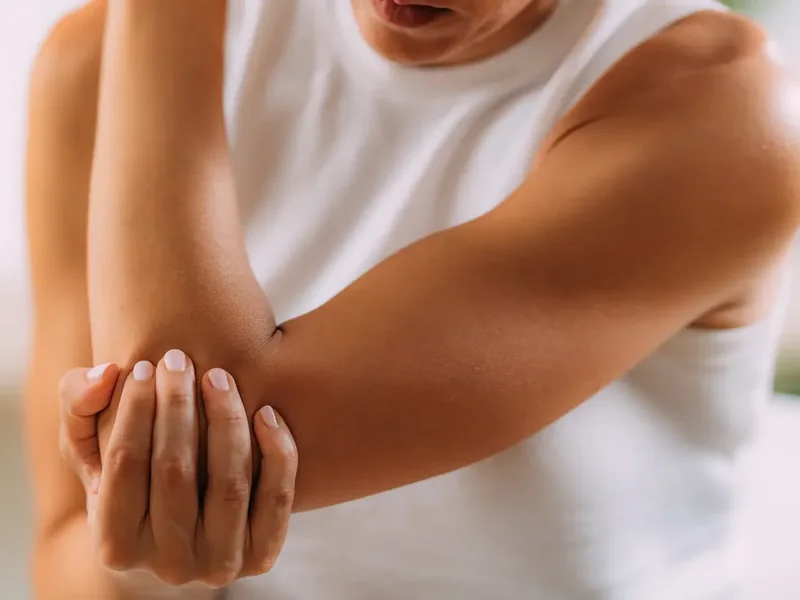
The tendons that lift your wrist anchor on the outside of the elbow. Repeated gripping, lifting with the palm turned down and long hours on a keyboard or a tool handle load that anchor faster than it can rebuild itself. The tendon does not tear so much as it degrades, which is why rest feels good for a week and then fails the moment you pick up a full kettle. It needs graded load, not time off.
On the inside of the elbow sit the tendons that curl your wrist and fingers. Gripping hard, twisting a screwdriver, swinging a club or carrying heavy bags loads them the same way tennis elbow loads the outside. The pain often runs down toward the wrist and sharpens when you squeeze. Treatment is not rest and a strap. It is restoring wrist and forearm mobility, then loading the tendon in a way it can actually adapt to.
Numbness, tingling and a hand that drops things point at a nerve rather than a tendon. The median nerve narrows through the carpal tunnel at the wrist and the ulnar nerve wraps the inside of the elbow, so both get compressed by swelling, sustained positions and a stiff neck or shoulder further up the line. We test the whole path, because releasing the wrist rarely helps when the real compression sits above it.
A wrist that was splinted or a finger that was pinned heals, but the joint capsule around it shortens while it is held still. You end up with bone that is solid and motion that is not, and scar tissue binds tendons that used to glide freely. Left alone, the arm learns to work around the stiffness and the shoulder starts to complain. Restoring glide and range early is what keeps a healed injury from becoming a permanent limitation.
Weakness is usually the cause, not the consequence. When the forearm and hand cannot produce force, every task pushes that demand onto the tendons and the small joints instead. You feel it first as a jar lid you cannot open, then as an ache after work, then as pain that starts before you begin. Measuring grip on both sides tells us how far the deficit runs and gives us something concrete to rebuild toward.
The nerves that supply your hand start at the neck, and the shoulder blade sets the angle every arm movement works from. A neck that has lost rotation or a shoulder blade that does not stabilize leaves the elbow and wrist absorbing load they were never built for. This is why elbow pain treated only at the elbow keeps coming back. Your neck and shoulder get examined on the first visit for exactly that reason.