Fittees Physical Therapy and Wellness

Foot & Ankle Pain Treatment in Sachse

The first steps out of bed are the worst part of your day, and you have quietly started planning your walking around them.

01What Causes It

What causes foot and ankle pain?

Your foot has opposite jobs to do on every single step. It has to go soft to absorb the ground, then stiff to push off it, and it has to switch between those states almost instantly. When something in that sequence stops working, the load does not disappear. It moves to the heel, the arch, the outside of the ankle or the front of the shin, and it stays there until the mechanics change. That is why heel pain outlasts the rest, the ice and the new shoes.
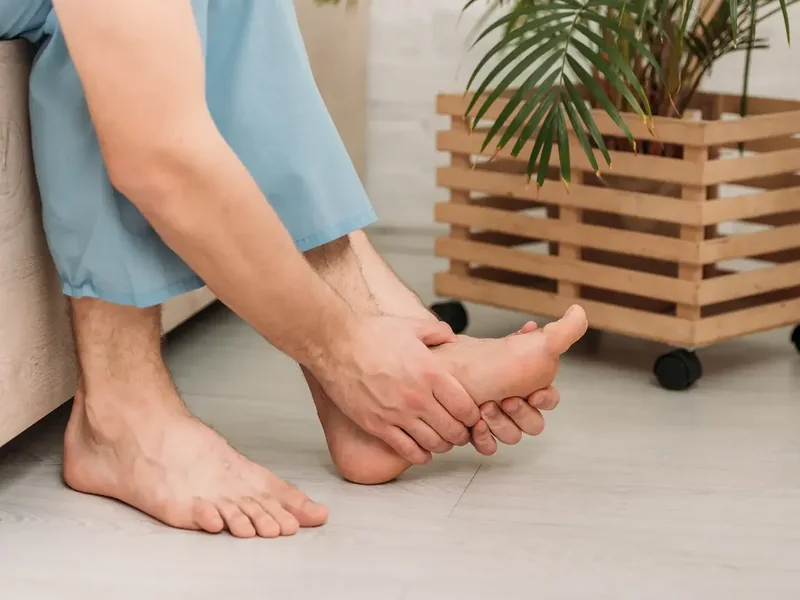
Doctor of Physical Therapy assessing ankle motion and arch control during a foot evaluation in Sachse

The plantar fascia is a thick sheet of tissue under your arch that tightens overnight and gets loaded the instant your foot hits the floor. That is the stab you feel with the first steps of the day. It rarely fails on its own. A stiff ankle, a tight calf or a big toe that will not extend forces the fascia to take strain that was meant for the whole foot. Stretching the sole alone treats the symptom and leaves the cause running.

A sprain damages the ligament and the position sense stored inside it. The swelling settles, walking returns, and the ankle gets declared healed while its balance reflexes are still offline. That is why the second sprain comes easier than the first, and the third easier still. Restoring strength and single leg balance is what closes the injury properly, and it works whether the sprain happened last month or years ago.

The Achilles absorbs more force than any other tendon in your body, and it responds badly to sudden change. A new running program, a job on concrete or a switch to flatter shoes can tip it over. Pain and thickening in the tendon, worse first thing in the morning and warming up once you get going, is the classic pattern. The tendon needs progressive, calculated loading. Complete rest leaves it weaker than it started.

Neither foot shape is a diagnosis on its own. Plenty of people have flat feet and no pain at all. The problem starts when a foot cannot control the position it collapses into, so the arch, the shin and the knee absorb the difference on every step. We test whether your foot can produce the stiffness it needs at the right moment, then train it. Arch support is a useful tool, not the whole answer.

Your ankle has to let the shin travel forward over the foot for you to squat, walk downhill or run comfortably. Old injuries and long spells in stiff shoes take that motion away, and the body simply borrows it from somewhere else, usually the arch or the knee. Measuring and restoring that range often resolves foot pain that never responded to treatment aimed at the foot itself.

Tissue adapts to what you ask of it, but only at a certain rate. A new job on your feet, a spring race plan, a move to minimal shoes or a summer in flat sandals all raise demand faster than the foot can build tolerance for it. The tissue is not damaged so much as overtaken. Backing load down to what you can handle, then rebuilding it on a schedule, is the treatment.
Manual therapy applied to the heel and calf during a one on one foot and ankle session
02How PT Helps

How physical therapy in Sachse helps.

Dr. Egbuzie watches you walk before she touches anything, because foot pain is a loading problem and loading only shows itself in motion. Then the ankle, the big toe, the calf and the arch get tested individually, so we know which link is short. No referral is needed to start. Texas is a direct access state, so you can book an evaluation without seeing a physician first. Treatment pairs hands-on work that restores the motion your ankle has lost with graded loading that rebuilds what the tendon or fascia can tolerate. Where the calf will not release, dry needling and instrument assisted work get there faster than stretching does. Sessions run 45 to 60 minutes with your Doctor of Physical Therapy, one on one, and most patients feel a meaningful change inside the first two or three visits.

03What To Expect

What to expect from your recovery.

01

The evaluation

We watch you walk, test the ankle and big toe for the motion they should have, check calf strength and single leg balance, then load the painful tissue to see what it tolerates. You leave with the diagnosis, the plan and the cost. Fittees is in-network with Blue Cross Blue Shield, UnitedHealthcare, Cigna and Medicare, and for other plans we provide a superbill so you can file for reimbursement.

02

Taking load off the angry tissue

Early sessions bring the pain down far enough for you to move normally again. Manual therapy restores ankle and toe motion, soft tissue work releases the calf, and we adjust your daily load: shoes, surfaces, mileage, hours on your feet. Walking without guarding is the goal here, because a limp spreads the problem to the hip and knee.

03

Rebuilding the foot for real ground

Calf, foot and hip strength go in progressively, along with the balance work your ankle lost when it was injured. We rebuild toward your actual demand: the stairs at work, the trail you run, the shift you stand through. A typical plan runs two to three visits a week for four to six weeks, then you continue on your own program.

In Their Words
Feet do not fail because they are weak by nature. They fail when the load asked of them outruns the tolerance built into them, and tolerance is trainable.
Fittees Physical Therapy and Wellness
Related Conditions

Pain rarely travels alone.

Request an Appointment

Ready when you are.

HoursMonday - Saturday
Walk-insCall ahead
Book your evaluation. Same-week appointments available.
Step 1 of 5
First things first. What's your name?
We'll need a name to book you in.
Best number to reach you?
A phone number lets us confirm same-day.
And your email?
We'll send your confirmation here.
What questions do you have about your foot or ankle?
A few words is all we need.
Look right? Send it.
✓
Request received.

We'll call within business hours to lock in your time.

Schedule Appointment